



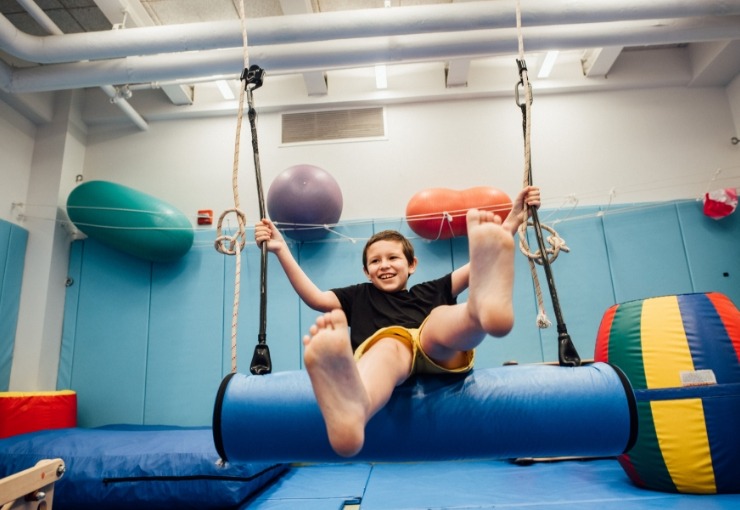

Occupational Therapy at MCC is a core “related service” embedded in a transdisciplinary educational framework,
MCCs’ and MBCs’ instructional approach integrates ABA principles alongside speech and occupational therapies, with an explicit commitment to collaboration among disciplines and with families.
In that regard, Occupational Therapy does not function as just a separate add-on service.
Occupational therapists are working “hand in hand” within the larger team of classroom teachers, speech-language pathologists, job coaches, adaptive physical education coaches, and musical therapists to accelerate learning and skill acquisition.

Core OT focus areas (skills and performance domains)
Occupational Therapy School is provided within a notable “lifespan school-age to transition-age” framework (participation, independence, community integration, and inclusion), not limited to fine motor or sensory-only support.
Occupational therapists use purposeful activities that integrate multiple foundational skill sets, including:
- Sensorimotor and sensory processing skills
- Visual-perceptual and cognitive skills
- Fine motor and graphomotor skills
- Gross motor coordination skills
These foundation skills translate to occupational performance domains, including:
- Sensory processing and self-regulation
- Academic skills (handwriting, typing, use of computer technologies)
- Activities of Daily Living (ADLs) / self-care (feeding, dressing, grooming, and personal hygiene)
- Instrumental ADLs (IADLs)
- Safety awareness
- Assistive technology
- Health and wellness
- Leisure
- Self-determination
- Pre-vocational and vocational skills
Service delivery model (how OT is provided day-to-day)
While the service provision model might present with some differences between the Lower and Upper School Division, OT service provision focuses on supporting participation in “meaningful activities” across school, home, and community environments, to promote independent function across all domain of performance and generalization across all environments
Students receive OT through multiple service formats, including:
- Individualized OT sessions (student-specific intervention)
- OT focused group instruction
- Transdisciplinary group instruction for Upper School Students
- Lunch/leisure-time consultation
- Virtual Reality-based skill development
From an OT lens, this is essentially occupation-based intervention in real or simulated contexts, aligned with IADLs, safety, mobility in the community, and pre-vocational participation.
Generalization of targeted skills to natural contexts is facilitated through
- Increased time within treatment sessions spent in the community
- Shopping and restaurant routines
- Safety skills and emergency preparedness
- Leisure skills
- Public transportation
- Pre-vocational/vocational training targeted both simulated and natural ‘work’ environments
- Job exploration
- Vocational skills
- Units run in 4–6 week cycles
- Partnerships with local businesses and first responders (examples given include FDNY and NYPD)
- Integrated “co-treat” model to embed OT goals in daily classroom instruction and routines, so students have multiple opportunities to practice and generalize targeted skills.
- One weekly OT session includes a co-treatment with the classroom instructor, or MCC also specifies operational features:
Transition services (OT role in assessment, planning, and training)
Occupational therapists are an integral part of the transition planning team, including responsibilities across:
- Contributing to “all necessary assessment aspects”
- Developing the transition plan
- Participating in student training across functional performance areas such as:
- Independent living
- Vocational training
- Wellness habits and routines
Family collaboration and caregiver education
OT collaboration extends to families/caregivers through:
- Constant communication
- Parent education via in-person/hands-on training
- Workshops
Families are “equal partner[s]” in the educational process and are empowered in that role as open-door collaborators with the larger MCC team.
Technology and “future-facing” OT programming (coding example)
OT has always been exploring ways to incorporate the latest technologies into the intervention landscape. These include:
- Coding,
- Video gaming,
- Virtual reality,
How OT supports academic, social, and emotional development.
Occupational Therapy is explicitly positioned to strengthen students’ participation in school routines and learning, while also targeting self-regulation and functional independence through integrated (co-treated) instruction and natural-context practice.
Academic development
- Builds “learning-ready” foundations that directly support classroom performance: MCC notes OT uses purposeful activities targeting fine/gross motor, sensory processing, visual-perceptual, and cognitive skills—all prerequisites for accessing instruction, materials, and classroom routines.
- Accelerates skill acquisition through embedded collaboration
- Pushes practice into daily instruction via co-treats
- Supports access through assistive technology and tech-enabled routines)
Social development
- OT Targets participation in leisure and real-world community contexts:
- Directly contributes to community-based instruction (CBI):
- Builds interpersonal and teamwork skills in “life skills” routines, by building interpersonal and leisure skills
Emotional Development at MCC
- Sensory-regulation and emotional-regulation is a central OT outcomes. Students are introduced to self-regulation awareness training through the Alert Program and Zones of Regulation curricula, which are closely related to the Social Thinking Curriculum.
- Sensory and emotional regulation strategies are promoted through co-treatment and natural contexts:
Examples of student progress due to OT interventions.
MCC has concrete, program-based examples of the types of functional gains students work toward (and practice) through OT-integrated instruction, community-based work, and life-skills programming.
Increased independence in self-care and ADLs
- Students become more independent with feeding, dressing, grooming, and personal hygiene:
- Tolerating and incorporating a larger food repertoire
- Tolerating toothbrushing
- Tolerating hair brushing
- Tolerating nail clipping
- Tolerating Hair cutting
- Tolerating and participating in dentist visits
- Tolerating and participating in doctor visits
- Tolerating vaccinations and blood drawn procedures
Home-management and IADL competence
- Folding clothes, making a bed, organizing belongings
- Completing household chores like dusting and vacuuming, setting the table for a meal, loading and unloading a dishwasher
- Practicing laundry and sweeping
- Meal preparation, food routines, and task sequencing:
- toaster oven, blender, air fryer safe usage
- Completing recipes
- Food portioning
- Cleaning after meals
- Making lunch
Stronger community participation skills (generalization beyond school)
- Shopping and restaurants
- Safety skills and emergency preparedness
- Public transportation
- Job exploration and vocational skills
Improved executive-function and “learning-to-learn” behaviors via OT activities
- Problem-solving
- Planning
- Attention
- Navigation (The Manhattan Childrens Center – Occupational Therapy School, New York City )
Collaboration between OT and teaching staff.
MCC Occupational Therapy (OT)–teacher collaboration integrated, routine-embedded, and explicitly structured to promote skill generalization, rather than functioning as a separate “pull-out” service.
How OT benefits extend beyond the classroom.
OT is intentionally structured to produce carryover—so skills acquired in therapy translate to students’ functioning in home routines, community participation, and long-term independence, not only classroom performance.
A concrete “beyond the classroom” example is the Life Skills Apartment, which is directly supporting real-life routines—hygiene, meal preparation, home maintenance, and fitness—with tasks like laundry, sweeping, brushing teeth, and making lunch selected to build sensory regulation, motor planning, and executive function.
Evidence or research supporting OT practices in autism education.
- Domínguez-Lucio, S., et al. “Occupational Therapy Interventions Using New Technologies in Children and Adolescents with Autism Spectrum Disorder: A Scoping Review.” Journal of Autism and Developmental Disorders, vol. 53, no. 1, 2023, pp. 332–58, https://doi.org/10.1007/s10803-022-05431-3.
- Mowell, Megan, et al. “Exploration of Common Sensory Interventions Utilized in School-Based Occupational Therapy.” Journal of Occupational Therapy, Schools & Early Intervention, vol. 16, no. 2, 2023, pp. 212–24, https://doi.org/10.1080/19411243.2022.2027839.
- Rekoutis, P. A. (2023). Providing Occupational Therapy for Individuals with Autism.
In Willard and Spackman’s Occupational Therapy (14th Ed.). Baltimore, MD: Wolters
Kluwer. - Rekoutis, P. A., (2013). Parents of Children with Autism: LAP Lambert Academic Publishing. AG & Co. KG, ISBN-13: 9783659144165.
- Tomchek, Scott, et al. “Occupational Therapy Interventions for Adolescents With Autism Spectrum Disorder.” The American Journal of Occupational Therapy, vol. 71, no. 1, 2017, pp. 7101395010-7101395010p3, https://doi.org/10.5014/ajot.2017.711003.
- Watroba, Anni, et al. “Effectiveness of School-Based Occupational Therapy Interventions on School Skills and Abilities Among Children with Attention Deficit Hyperactivity and Autism Spectrum Disorders: Systematic Review.” Journal of Occupational Therapy, Schools & Early Intervention, vol. 17, no. 3, 2024, pp. 671–703, https://doi.org/10.1080/19411243.2023.2224793.